Wednesday, September 8, 2010
L'SHANA TOVA TO YOU ALL!!
Here's a happy little post.
I wish you all a wonderful holiday filled with meaning, learning and joy.
Monday, March 29, 2010
Chag Sameach!
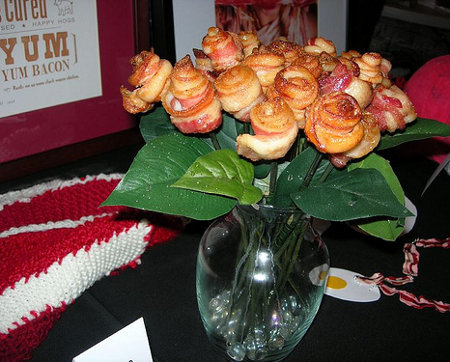
What better way to celebrate than with a bouquet of bacon flowers? Perfectly Kosher for Passover, right?
Sunday, February 28, 2010
Thursday, January 21, 2010
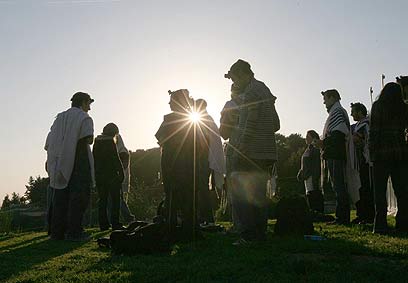
Teen Wrapping Teffilin Evokes Terror Fears on Flight
So, once again we see a fantastic example of ignorance leading to needless arrest. To quote the Daily News article:
Although the teen explained the significance of the tefillin to the crew, the pilot opted to land the plane in Philadelphia anywa.
Saturday, January 9, 2010
Wednesday, December 16, 2009
Yeshiva University Students Create Wind-Powered Menorah
It's fueled by Saturday evening Chullent.
Friday, December 11, 2009
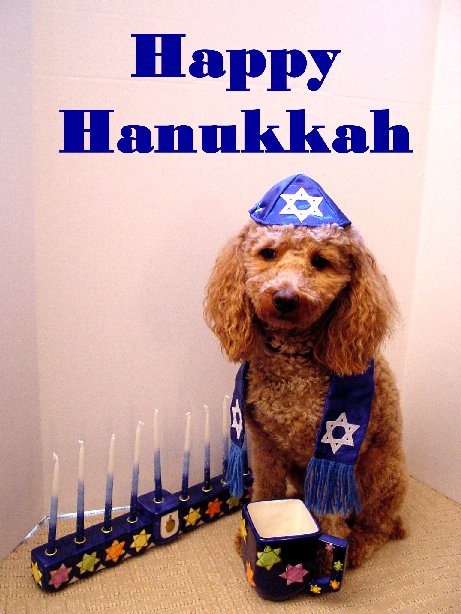
Hanukkah Sameach!
HAPPY HANUKKAH!!! And Chanukah and Channukkaahh and cchhhhhhhanukkah.
Don't forget, the first candle is lit at 4:11pm tonight for you folks in the NYC area.
Wednesday, November 18, 2009
The 4th Annual Manischewitz Cook-Off Hosted by Chef Jacques Pépin
I'm thinking about entering a recipe for deep friend bacon cheese nuggets. That's kosher, right?
Wednesday, July 1, 2009
'New York Jew' wine
No, not kosher, but pays homage to the Jews of NY. Interesting to say the least.
Tuesday, June 16, 2009
Orthodox Jews launch kosher search engine
It is called Koogle. Amazing. I still prefer to eat Kugel, and search with Google.
Tuesday, May 26, 2009
Sunday, May 17, 2009
Wednesday, April 8, 2009
An overview of Passover and Kosher for Passover
This post is the result of some unsettled emotions that stem from an unfortunate incident a few years back.
At the time I was living happily with a bunch of friends from school. One of these pals, Sam, is also Jewish. Sam and I decided that we were going to keep Kosher for Passover, and we were going to do it as strictly as possible.
Now, don’t get me wrong, ordinarily my insatiable thirst for bacon negates any and all kosher eating I might consider, but during Passover I do my best to be observant. I fight and struggle all week, dreaming of bacon egg and cheese on a bagel sandwiches from the diner, but I always seem to prevail. I think apart from any religious aspects to the holiday observance, I like know that I’m not a total slave to my desires, and that I have some will power. I don’t think it is bad to test yourself every once in a while. But, I digress…
Sam and I went out, bought all Kosher food, segregated our food from the rest of what was in the house (except for the Gefilta fish jar I hid in Mike B’s bed, I think he’s still angry about that) and proceeded to clog our innards with Matzo. Hey, they call it the bread of affliction for a reason. I don’t remember exactly what it was we were eating, but while looking at a food label, we discovered that “Parve” does not mean Kosher for Passover; it means that the food is neither dairy, nor meat. There needs to be a letter P next to the Kosher certification mark on any food that is Kosher for Passover. An example from a Coca-Cola bottle is above.
Now, say what you will about our lack of knowledge about our own religion, but the fact is, we tried, and we really cared. Sam and I were both pretty upset that we had broken our Passover commitment in such a manner. A hard lesson learned, but one that will ALWAYS stay with me. I hope that this post helps someone out there avoid the same mistake Sam and I made. That material below has been taken from the most reliable sources I know of on this topic:
The Kosher Overseers of America (http://www.kosher.org/)
“The World’s Best Known Kosher Trademark” (http://www.oukosher.org/),
“The Premier Kosher Information Source on the Internet” (http://www.kashrut.com/)
Star K Kosher (http://www.star-k.org/)
I’ve focused mainly on the dietary restrictions in regards to Chametz (also spelled Chumetz by some). Obviously, all standard rules of Kosher still apply during Passover. I recommend reading some of the links at the bottom of this post for more information about how to properly clean and prepare a home for Pesach. People forget that this is a very pious, detailed and important holiday.
What Does Kosher for Passover Mean?
During Passover, Jewish law forbids the consumption or possession by Jews of all edible fermented grain products (chametz) or related foods. Therefore, even foods and household products which meet the strict, year-round dietary regulations and are considered kosher, are nevertheless often unacceptable, or require special preparation for Passover use in the Jewish home in order to be kosher for Passover.
Which Foods are Chametz?
If one of the five grains – wheat, barley, rye, oats and spelt – sits in water for more than 18 minutes it becomes chametz, and one may not eat, derive benefit from, or own it on Pesach. In addition, Ashkenazim (generally defined as Jews of European descent) don’t eat kitnios – a group of foods which includes (among other things) rice, corn, soy and their derivatives – but are allowed to own kitnios foods on Pesach.
What is Kitniyot?
In addition to the Torah’s restrictions on owning, eating and benefiting from chametz, an Ashkenazic minhag developed in the middle ages to not eat certain foods known collectively as “kitnios”. The Mishnah Berurah (453:6 & 464:5) cites three reasons for the minhag (a) kitnios is harvested and processed in the same manner as chametz, (b) it is ground into flour and baked just like chametz [so people may mistakenly believe that if they can eat kitnios, they can also eat chametz], ( c ) it may have chametz grains mixed into it [so people who eat kitnios may inadvertently be eating chametz]. Although initially there were those who objected to the minhag, it has become an accepted part of Pesach in all Ashkenazic communities.
Kitniyot List
The following are considered Kitniyot:
Rice
Millet
Soybeans
Peanuts
Corn
Sunflower Seeds
Buckwheat
Sesame Seeds
Poppy Seeds
Cardamom
Fenugreek
Rapeseed
Mustard
Peas
Beans
Lentils
The following are not considered Kitniyot:
Coriander
Anise
Cumin
Caraway
Fennel
Linseed
Cottonseed
Guar Gum
Locust Bean Gum
Carob
The following may be Kitniyot and are therefore not used:
Quinoa
Amaranth
Who Can Eat Egg Matzah?
According to the Shulchan Aruch, dough made from flour mixed with fruit juices or eggs will not become chametz no matter how long it stands, provided no water is added. Despite this ruling, Ashkenazic practice mandates that egg matzot may only be used by the elderly and the infirm. Furthermore, all the precautions associated with ordinary Passover matzot apply to egg matzot. The egg matzah must be baked thin, in specially heated ovens for less than eighteen minutes and must be carefully guarded from becoming chametz during production. (Sephardic custom commonly permits different varieties of flour-juice mixtures even when not produced as matzah.) Although the allowance to eat egg matzah over Passover applies in the above-mentioned cases, one cannot fulfill the mitzvah of eating matzah on Seder night with egg matzah. The Torah refers to matzah as “lechem oni” poor man’s bread, because it is made solely from flour and water, the simplest of ingredients. Egg matzah is called “matzah ashirah,” rich man’s bread, for it contains more complex ingredients and is unacceptable for the mitzvah of matzah. Therefore, even the elderly or infirm should (if they are able) eat a kezayit of shmurah matzah on the night of the Seder.
Some Good Links (some are links to PDF files):
http://www.oukosher.org/pdf/Passover_for_Beginners.pdf
http://oukosher.org/index.php/passover/article/which_foods_are_chametz/
http://oukosher.org/index.php/passover/article/kitnios/
http://program.ouradio.org/content/oukosher/PESACH_09.pdf
http://www.star-k.org/kashrus/star-k09_pesach_directory.pdf
Obama to host Passover Seder at White House
Via Fox News:
President Obama is hosting a Passover seder at the White House on Thursday for friends and family, the second day of the eight-day Jewish holiday commemorating the end of the Jews' enslavement in Egypt.
A White House official told FOX News that Obama participated in a Passover seder with staff and a few friends last year while on the campaign trail in Pennsylvania, and enjoyed it so much he played off the traditional refrain at the end of the seder, yelling out "Next Year in the White House."
The aide said that the seder was a "welcome moment of reflection and rest" from the rigorous campaign and is now set as a time for the president's staff to regroup.
"This year's seder is meant not only to celebrate the holiday, but also to reflect on all that has happened in our lives since last year's seder in Harrisburg," the aide said. "This is apparently the first time a president has participated in a seder at the White House."
President Clinton's staff held seders during the holiday but the president did not attend.
People have been commenting that Obama is just doing this as a way to make all the rich Jews in Hollywood happy since they gave him campaign money. How come nobody complains about White House Easter Egg hunts? I'd be just as happy to see Obama celebrate a Hindu festival. I think a Seder in the White House is a wonderful thing, and not just because I'm Jewish.
Today is the rarest event in the Jewish Calendar
Jewish Action - The Magazine of the Orthodox Union - OU.ORG - Fantastic summary of the event, complete with links to prayers for today.
This is one of the most interesting events in Judaism I've never heard of, so I'm now spreading the word.
This event occurs on Erev Pesach this year, making for a very special start to the holiday.
Posted using ShareThis
http://en.wikipedia.org/wiki/Birkat_HaHammah - My sources (Hillel G) tell me that this wikipedia entry is fairly accurate.
Tuesday, March 24, 2009
Having a Bat Mitzvah in Their 90s Because It’s a Hoot
BEACHWOOD, Ohio — Ann Simon is worried she might forget all the Hebrew words she has memorized to become a bat mitzvah, a Jewish girl marking the transition into religious adulthood.
Ms. Simon is no 12-year-old, though. At 94 she can be forgiven her fear that she might be seized by a senior moment or two as she stands on the bimah on Sunday to recite the section of the Torah that was read in synagogue on the Saturday closest to her 12th birthday. So can the other nine women who will take part in the bat mitzvah ceremony at the service in the synagogue of the Menorah Park senior residence in this Cleveland suburb.
The youngest, Mintsy Agin, will turn 90 in July. The oldest, Molly Kravitz, will celebrate her 97th birthday in August.
The women grew up in the shadow of the Great Depression, when bar mitzvah ceremonies for boys were weekly affairs but Jewish girls came of age without notice or fanfare.
A bat mitzvah was rare in the United States until the 1950s and ’60s, said an associate rabbi at Menorah Park, Howard Kutner. Since then, many adult women have decided to make up for what they were denied as children, but most who do so are in their 50s and 60s, Rabbi Kutner said. A septuagenarian is rare and a nonagenarian nearly unheard of, he said, but only those in or near their 90s showed up when he offered bat mitzvah instruction to Menorah Park women of any age.
“Most people in their 90s, they just eat their three meals a day and are happy to be alive,” Rabbi Kutner said. “I think this shows that at any age you can set a challenge and meet it.”
A challenge, perhaps, but not all the women see it quite that way. “My first thought was boy, what a hoot!” said Millie Danziger Fromet, 90.
A self-described “feminist all my life,” Evelyn Bonder, 90, said she “always thought girls should have the chance to participate” in something that Conservative, Orthodox and Reform congregations embraced in stages.
Ms. Agin said: “My daughter had a bat mitzvah. But it was on a Friday instead of a Saturday. It wasn’t held inside the synagogue, and she wasn’t allowed to read from the Torah.”
The women have met weekly with Rabbi Kutner to study Hebrew and the Torah in preparation for the service, which is scheduled for Sunday.
The rabbi had planned to hold the ceremony in January, but he bumped it back to give the women more time to prepare. “The joke went around the room: Let’s not do it after March,” he said. “Who knows if we’ll still be here!”
On a recent Monday, the women entered Menorah Park’s synagogue for a dress rehearsal. Three used walkers. Another carried a small oxygen tank. As they rose to speak, they left their medical gear by their seats. They approached the bimah unassisted, some limping, and steadied themselves at the lectern with both hands.
Practice began with prayers in Hebrew. Some women stumbled and stuttered through the complicated scrum of consonants. Those who had taught Sunday school for decades spoke more fluidly.
“One generation to another praises thy works,” said Eva Rosenberg, 91, reading from Psalm 145. “They speak of thy awe-inspiring might, and I tell of your greatness.”
Next came the speeches, which traditionally respond to the Torah passage read in synagogue that week. Rabbi Kutner had consulted old calendars to determine the week in which each woman would have spoken at age 12. He asked them to prepare messages based on the passages they would have addressed eight decades ago.
When Ms. Bonder was a child during the Depression, her parents lost their life savings in a bank failure. She later served as an aide to a United States senator. Her speech drew parallels to her Torah reading about Joseph, who rose from slavery to become a pharaoh’s chief adviser.
Belva Singer, 91, meditated on the power of the Birkat Kohanim, the ancient Priestly Blessing.
“This is one of the oldest and most beautiful prayers,” Ms. Singer said. “It is only 15 words, and it has been repeated by our people for thousands of years.”
Class members argued intensely over whether to limit each woman’s speech to three minutes. The concern was not whether aging bladders could handle a ceremony that lasts an hour and a half, but whether relatives, some of whom are flying in from as far as Boston and California for the event, might be bored.
“These women have spent their entire lives nurturing other people, and now the spotlight is finally on them,” Rabbi Kutner said. “They were afraid of burdening their audience.”
They were not, however, afraid of telling the rabbi to pipe down.
“You’re overpowering me!” Ms. Simon yelled during a period of singing.
“Really?” the rabbi said with an embarrassed smile. “I’m sorry.”
The singing resumed. Rabbi Kutner followed along, silently mouthing the words.
“You’re doggone right we’re feisty,” Ms. Agin said at one point.
After Sunday’s ceremony, each woman is to receive a certificate with words from Psalm 92: “They shall be fruitful even in old age; vigorous and fresh they shall be to proclaim that the Lord is Just. He is my strength.”
The new “adults” of Menorah Park may beg to differ.
“We’re not old people,” Ms. Bonder said. “We’re senior adults.”
Ms. Fromet looked over and frowned. “No we’re not,” she said. “We’re adult seniors.”